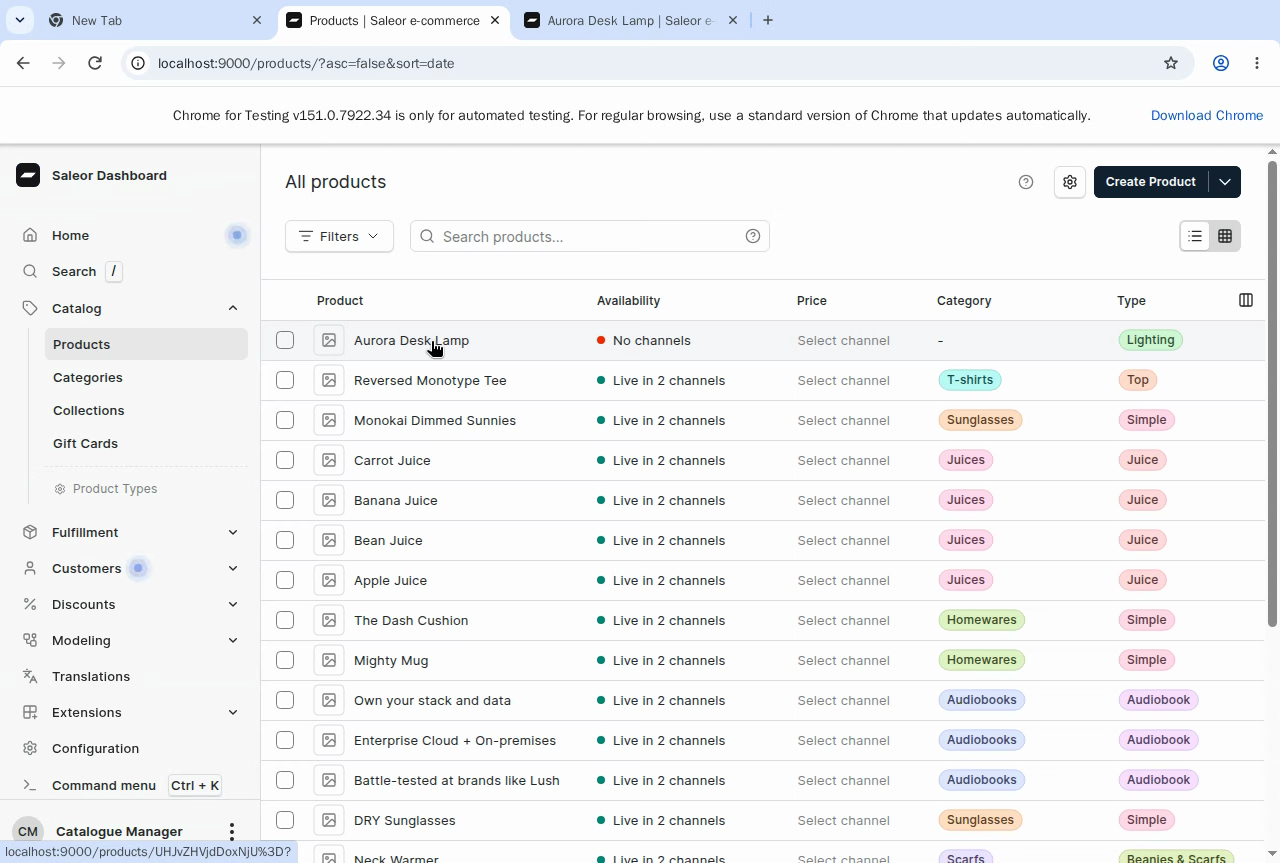
Scroll the product catalogue with touch gestures on a phone
Browse the product catalogue on my phone.
The intention is included in the agent’s input prompt alongside environment details and task instructions.
BeforeThe defect at the parent commit
0:00.00 / 0:00.00Frame 0 · Review the mobile catalogue
The orange circle and trail visualize the recorded touch gesture. The upward swipe leaves All products and opens a product detail page.
AfterThe same script once the merged fix is applied
0:00.00 / 0:00.00Frame 0 · Review the mobile catalogue
The orange circle and trail visualize the same recorded touch gesture. After the upward swipe, All products remains open without navigating into a product.
01 · Given
Restore the data and starting state.
A signed-in user is viewing the loaded All products list in a phone-sized touch viewport. Product rows provide access to individual product details.
02 · When
Perform the interaction.
The user swipes upward across a product row and releases the gesture.
03 · Judge
Rationale: Merchants browse the product catalogue to review their inventory and open individual products when needed. On a phone, swiping across product rows is a normal way to browse the list; it should not be mistaken for choosing a product to open.
Require
A swipe across a product row is treated as scrolling rather than opening the product. All products remains visible after the gesture ends.
Allowed
- A movement threshold, gesture cancellation, scroll state, or delayed activation may distinguish tap from drag.
- Taps, keyboard activation, or a separate details button may open product details.
- Scrolling may be short, have momentum, or stop at a boundary while the drag retains the list context.
Model
HarnessDeepSeek Flash
DSH
10.8M in · 58.2k out · 10.8M total
DSH · 108 steps · $0.15 · 29m 31s · 10.8M tokens
DSH
108
$0.15
29m 31s
10.8M
58.2k
10.8M
GLM-5.3 Flash
ZCode
16.0M in · 72.6k out · 16.1M total
ZCode · 167 steps · $0.54 · 49m 28s · 16.1M tokens
ZCode
167
$0.54
49m 28s
16.0M
72.6k
16.1M
Qwen3.8 Max
Codex
7.2M in · 58.6k out · 7.3M total
Codex · 95 steps · $2.64 · 49m 21s · 7.3M tokens
Codex
95
$2.64
49m 21s
7.2M
58.6k
7.3M
Kimi K3
Kimi Code
8.7M in · 51.3k out · 8.8M total
Kimi Code · 119 steps · $3.66 · 45m 18s · 8.8M tokens
Kimi Code
119
$3.66
45m 18s
8.7M
51.3k
8.8M
GPT-6 Astra
Codex
3.3M in · 15.7k out · 3.3M total
Codex · 50 steps · $5.37 · 17m 53s · 3.3M tokens
Codex
50
$5.37
17m 53s
3.3M
15.7k
3.3M
Claude Opus 5.5
Claude Code
2.0M in · 11.6k out · 2.1M total
Claude Code · 34 steps · $1.25 · 9m 12s · 2.1M tokens
Claude Code
34
$1.25
9m 12s
2.0M
11.6k
2.1M